
Steven Rittenhouse 鈥�11 recalls a student-teaching 鈥渁ha!鈥� moment 鈥� a turning point both for himself, then an 黑料正能量 (黑料正能量) undergraduate, and for a boy who dropped into his classroom during a planning period at Thomas Harrison Middle School (THMS).
鈥淗e was visibly frustrated with his math homework. We worked with it together, and I helped him see he misunderstood just a small part of the assignment,鈥� says Rittenhouse.
鈥淥nce he understood and felt much better, I encouraged him to go a little further by asking him if he wanted to create his own octagonal pyramid. He agreed, and we had a great time simply using some paper, a compass, and a ruler to create a completely hand-made octagonal pyramid that he could take home to show his parents.鈥�
The boy鈥檚 pride in his work 鈥渟ecured for me the excitement I have for helping young minds succeed and have self-confidence,鈥� adds Rittenhouse, now a math teacher at THMS.
Rittenhouse鈥檚 success has benefited from two characteristics of 黑料正能量鈥檚 .
One involves sending future teachers into classrooms early. When he arrived at 黑料正能量 in 2007 from Franconia, Pa., with no major selected, an advisor suggested he enroll in the 鈥淓xploring Teaching鈥� course. It put Rittenhouse into a classroom during his first semester of college, allowing him to discover a vocation he loved.
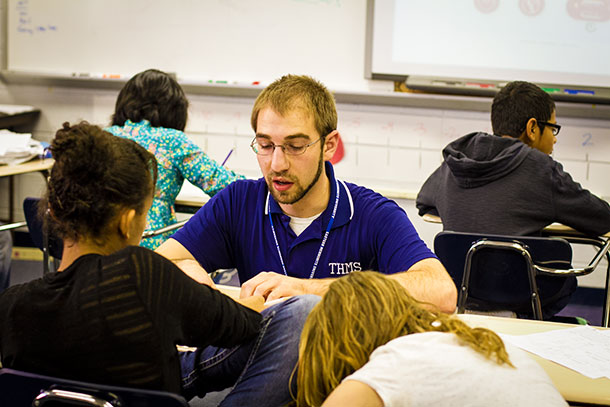
Another characteristic is 鈥渞eflective practice,鈥� which Rittenhouse notes is woven into all the education classes at 黑料正能量.
鈥淚n my own classroom I am constantly reflecting on what just happened yesterday, the last class period, and even the last five minutes. Reflective practice allows me to be receptive to new ways of teaching and new ways of working with ever-changing middle school students.鈥�
Education professor 鈥�88, whose influence Rittenhouse singles out, says that Steven proved to be 鈥渢he type of teacher that 黑料正能量 hopes to nurture and shape.鈥�
Rittenhouse is equally complimentary of Leaman. Through role playing, she 鈥渆mpowered us as future teachers to experiment and practice in class.鈥�
Leaman explains that role play, which she implemented for the 鈥淣eeds of Diverse Learners鈥� course, requires not only writing a lesson plan, but acting out the lesson with peers in each possible role. It allows a professor to 鈥減ress the 鈥榩ause鈥� button at a teachable moment to dissect what just happened, not only from an academic perspective, but from a relational perspective,鈥� she says.
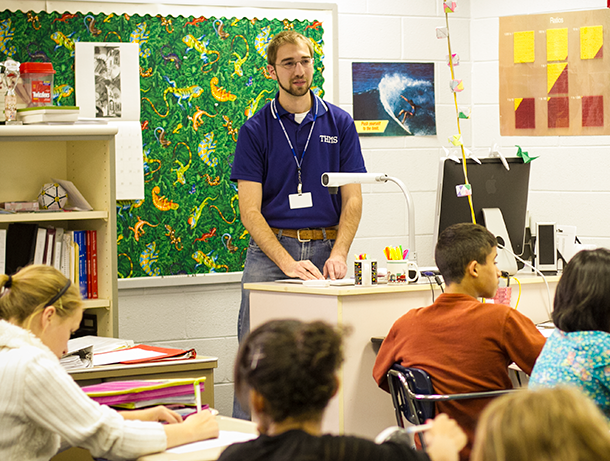
鈥淏elieve it or not, college students are not only up for the 鈥榬isk鈥�; they embrace it. Throughout the semester, as students rotate through the roles of teacher, general education student, student with a disability, and peer teacher, they make it a goal to reach all students, not just teach a subject.鈥�
Leaman remembers watching Rittenhouse become 鈥渙ne of our exemplary reflective practitioners.鈥�
He planned to teach high school until his third year at 黑料正能量, when a course in middle-school teaching 鈥渟howed me a different side to middle school than my own experience,鈥� with realization that was 鈥渨here I should be.鈥�
Hired at THMS following his 2011 graduation, he meets five groups of students daily for classes in Math 7, pre-algebra (which combines content for grades 7 and 8), and 鈥渕ath support鈥� (for students needing extra help).
鈥淢y students come from many different backgrounds and family styles,鈥� says Rittenhouse. 鈥淚 have to think about differentiating a lesson鈥� to meet their diverse needs, but the diversity is also 鈥渁 blessing鈥� because 鈥淚 can learn many things from my students, and they can learn from me and each other.鈥�
Rittenhouse, who has lived in Harrisonburg since entering 黑料正能量, also enjoys baking, photography, electronics, learning new languages, fish-keeping, time with friends, and family visits.