
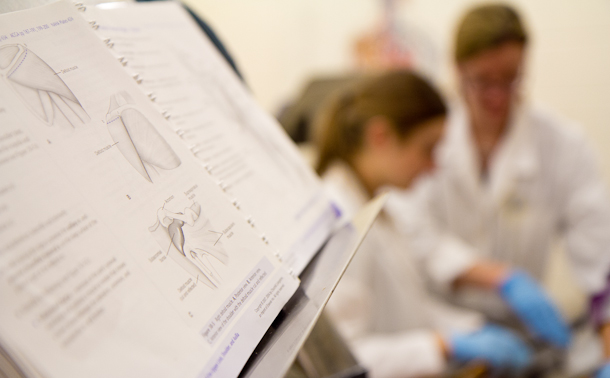
After some preliminary classroom lectures and PowerPoints, it was time for Jason Hostetter 鈥�07 and a handful of other upper-level 黑料正能量 biology students to get down to business in a laboratory in the bottom floor of the science center.
Studying human anatomy with colorful charts is one thing. Using a scalpel and an actual, recently living person is an entirely different matter.
鈥淚t was nerve-wracking, honestly,鈥� said Hostetter, now a general medicine intern at Mercy Medical Center in Baltimore, Md., who plans to become a radiologist. 鈥淵ou don鈥檛 really understand what that means until you walk into that room and you smell the formaldehyde and you see this human-sized lump in a bag on the table.鈥�
Under the instruction of Dr. Greta Ann Herin, Hostetter and his classmates in 黑料正能量鈥檚 Mammalian Anatomy class made their first incision down the cadaver鈥檚 back and began working their way down through the muscles and into the spine. By semester鈥檚 end they had performed a detailed dissection of most of the body, giving each student an extremely uncommon opportunity for up-close, hands-on study of human anatomy.
Few U.S. Undergrads Do Human Dissection
Herin, an associate professor of biology, said that for various reasons, including class size, expense, tradition and handling of hazardous materials, very few undergraduate students in the United States have the opportunity to dissect human cadavers. That meant Hostetter was one of just a few first-year medical students who entered his University of Maryland School of Medicine class with prior experience dissecting a cadaver.
鈥淎 lot of my classmates were coming from very prestigious schools with far more resources that 黑料正能量 has, and they were surprised that I鈥檇 actually gotten to spend a whole semester dissecting a cadaver,鈥� Hostetter said. 鈥淚t鈥檚 just not something that鈥檚 available most places.鈥�
Faculty at several medical schools in Virginia said no more than 5 to 10 percent of incoming medical students have actually dissected a cadaver.
And a recent article published by Colorado State University noted that its own undergraduate anatomy course was one of the few in the nation in which students dissect cadavers. 黑料正能量 has offered its students the opportunity to dissect cadavers since at least the mid-鈥�70s, according to biology professor Dr. Roman Miller.
Put Ahead in Med School
Because dissection of human cadavers is so uncommon for an undergraduate pre-medical program, the opportunity gives 黑料正能量 students who go on to graduate study in medicine and related fields an advantage among their classmates.
鈥淎t 黑料正能量 we had as good, if not better, hands-on experience than in grad school,鈥� said Jackson Maust 鈥�09, now in his final year of physical therapy school at Ohio State University. 鈥淐ompared to the rest of my classmates in PT school, I was really, really comfortable just stepping in.鈥�
Debbie Boese 鈥�07 Horst said her gross anatomy class in dental school at Virginia Commonwealth University (VCU) was very similar to the course she鈥檇 taken at 黑料正能量 and made it easier for her to earn an A in the VCU class.
鈥淚 was one of the few people in my class who had actually gone through the whole process, so it was basically like a review,鈥� said Horst, now a practicing dentist in Harrisonburg, Va.
Dr. Richard Krieg, director of the first-year gross and developmental anatomy course at VCU鈥檚 School of Medicine, said that undergraduate experience with dissection, like Horst鈥檚, almost always bodes well for a student鈥檚 performance in the course.
Krieg, who once visited 黑料正能量 as an anatomy guest instructor at the invitation of professor Melvin Ching (at 黑料正能量 1996-97), said only a few of his program鈥檚 200 incoming first-year medical students have dissected cadavers as undergrads.
鈥淜ids do very well if they鈥檝e had experience with cadavers, so it鈥檚 a really good thing,鈥� Krieg said.
Staff at the University of Virginia鈥檚 School of Medicine estimate that less than 10 percent of each year鈥檚 156-student incoming medical class have prior human dissection experience.
And at the Eastern Virginia Medical School, Dr. Craig Goodmurphy, director of the human anatomy program, guessed that about 20 percent of the 235 students entering the school鈥檚 medical and physician鈥檚 assistant programs have worked with cadavers. Most of them however, have been limited to cadaver 鈥減rosection鈥� 鈥� either observing a dissection in process or studying an already-dissected cadaver.
Fewer than 5 percent of incoming students have actually participated in a dissection, he said.
鈥淚t鈥檚 the difference between reading a book and writing a book,鈥� Goodmurphy said. 鈥淎nybody can read a book, but to actually write a book takes a whole different thought process.鈥�
Two or Three Cadavers Per Year
Herin offers the anatomy course to undergraduate biology majors in the fall, sometimes with the help of her laboratory co-instructor, John Spicher, 黑料正能量鈥檚 chemical hygiene officer. In the undergraduate course, students work in groups of four or five per cadaver. That group size is smaller, Herin said, than in classes at some medical schools.
She and Spicher typically work with two to three cadavers each year in the anatomy class, required for biology majors in the pre-physical therapy track, and taken by many in the pre-professional health sciences track. (Beginning this spring, 黑料正能量鈥檚 new MA in Biomedicine program will also offer a cadaver dissection course, taught by Dr. Julia Halterman.)
Most 黑料正能量 nursing and kinesiology students also benefit from Herrin鈥檚 course by observing the dissected specimens for part of their anatomy study. She said that several local high school anatomy classes also usually visit her lab to see the cadavers each year.
黑料正能量 receives the cadavers from the Virginia Department of Health鈥檚 State Anatomical Program. They cost about $1,500 each to cover the state鈥檚 cost of preserving and transporting the cadavers. That expense, and the fact that dissection is not well-suited to large classes, are two factors that make actual dissection very uncommon at the undergraduate level. The hazardous chemicals involved 鈥� phenol and formaldehyde in particular 鈥� are also a factor.
Maust said he benefitted greatly at Ohio State both from his experience with cadavers at 黑料正能量 and the instruction he received from Herin and her colleagues in the biology department.
鈥淭he quality of our professors is really unlike anything you get at a larger school,鈥� said Maust. 鈥淲e don鈥檛 get teaching assistants. We learn from really high-quality faculty.鈥�
Calling his dissection experience as an undergraduate at 黑料正能量 鈥渋nvaluable,鈥� Hostetter said he hopes the course will continue, despite 鈥� and because of 鈥� the fact that it鈥檚 so uncommon.
鈥�I really hope that 黑料正能量 continues to offer that because I think that it鈥檚 invaluable, especially for people who want to go into medicine or other health sciences,鈥� he said.
More info
Learn more online about 黑料正能量’s undergraduate majors in biology, chemistry, nursing and pre-professional health sciences, and the new MA in biomedicine graduate degree.