
HARRISONBURG, VA. — 鈥淲e have cracked the code of love,鈥� announced Sue Johnson, EdD, author of Hold Me Tight, to 1,200 people attending 鈥淐onversations on Attachment 鈥� Integrating the Science of Love and Spirituality,鈥� a three-day conference held at 黑料正能量.
鈥淲e are designed to live in community and in close relationships,鈥� Johnson explained in an interview with a reporter at a coffee break. 鈥淟ove is not an intoxicating mixture of sex and infatuation.鈥�
Instead love is having an emotional bond with others with whom we form 鈥渁 safe haven from the storms of life,鈥� she said. Johnson and several other internationally recognized speakers at the conference stressed that this type of love actually enables us to live longer, with less pain and sickness.
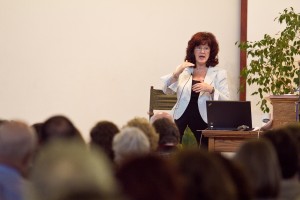
鈥淐ontact with a loving partner literally acts as a buffer against shock, stress, and pain,鈥� Johnson said in Hold Me Tight. Conversely, 鈥渆motional isolation is a more dangerous health risk than smoking or high blood pressure,鈥� she wrote, citing sociologist James House at the University of Michigan.
Of the five keynote speakers, Johnson and two others cited the results of several decades of research to support their assertions that caring relationships are as necessary to human life as air, food and water. The others referencing this research were neuroscientist James Coan, PhD, of the University of Virginia, and Dr. Daniel J. Siegel, a professor of psychiatry at the University of California-Los Angeles.
鈥淭he brain is a social organ, and our relationships with one another are not a luxury but an essential nutrient for our survival,鈥� wrote Siegel in his latest book, Mindsight 鈥� The New Science of Personal Transformation, to which he referred frequently in his presentation. Siegel also described how our minds work in synchronicity with those around us.
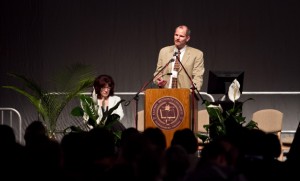
Throughout the conference, which began the evening of March 31 and ended at noon on April 2, 2011, 黑料正能量 philosophy professor , offered brief, heartfelt responses following the major speeches, often tying modern scientific insights into love with the 2,000-year-old teachings of Jesus. 鈥淚t is good for us to live in community,鈥� said Early. 鈥淚t is exhausting for us to live in isolation from each other.鈥�
Early added, however, 鈥淐ommunity can also be harmful.鈥� Strangers cannot betray us 鈥� it is those closest to us who can betray us, he noted. As a result, we must cultivate 鈥渉abits of repair,鈥� in order to heal harms that have been done, in addition to learning how to love healthily.
Cult of Individual Questioned
The conference served to challenge the mythic image in the United States of strength being embodied in a lone individual making his or her way self-sufficiently through life, pretending not to need long-term, committed relationships.
鈥淲e are seeing a paradigm shift away from the cult of the individual and back to nurturing relationships,鈥� said , a professor in 黑料正能量鈥檚 counseling department. 鈥淭his will be world-changing.鈥�
Conference organizers expected about 700 participants, mostly from 黑料正能量, but attendees from the community inflated the total to 1,200. Filling much of the University Commons arena, the audience included retirees, church personnel and health-care providers from the community (Rockingham Memorial Hospital was a co-sponsor).
As the developer of Emotion Focused Couples Therapy (EFT), Johnson led a day-long, pre-conference training on EFT for 300 people in the mental health field.
鈥淔orget about learning how to argue better, analyzing your early childhood, making grand romantic gestures, or experimenting with new sexual positions,鈥� Johnson said in her book and paraphrased in her speech. 鈥淚nstead, recognize and admit that you are emotionally attached to and dependent on your partner in much the same way that a child is on a parent for nurturing, soothing, and protection.鈥�
In the conference, Johnson, Coan and Siegel all made reference to the parent-child attachment studies begun after World War II by British psychologist John Bowlby. His Canadian assistant, Mary Ainsworth, continued this research through the 1990s, becoming a renowned psychologist in her own right. This research has now has been replicated and expanded by hundreds of other researchers; it demonstrates a child鈥檚 critical need for resonating with at least one caring adult in order to develop healthily.
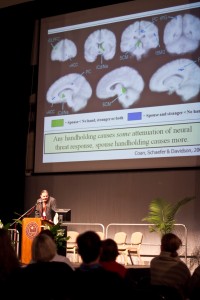
Using MRI imaging of the brain, Coan and other researchers have found that interpersonal relationships, particularly secure ones, have a measurable impact on brain activity. If someone feels threatened 鈥� resulting in a fight-flight-freeze response 鈥� this can be monitored via the 鈥渟ignal change鈥� in his or her right amygdala, said Coan in his keynote speech. This signal increases to a high level when the threatened person is alone. The signal is attenuated by having a stranger present. It registers lowest 鈥� meaning,聽 fewest signs of stress 鈥� when a partner is present.
This new research by Coan and others is revolutionizing the field of psychology. It聽 strongly suggests that humans are intended to live in relationship with others (that is, in families and communities), not as isolated individuals 鈥� in short, our brains function optimally when we have supportive relationships with others.
Conversely, if someone feels socially rejected, it registers in the same part of the brain (the anterior cingulate cortex) as physical pain does, according to research cited in Siegel鈥檚 book.
Underlying Spiritual Message
As he was wrapping up his presentation, Coan said with a smile, 鈥淚鈥檝e never been invited to speak about spirituality at any conference, or about God.鈥� In that respect, the 黑料正能量 conference was 鈥渦ncharted territory,鈥� he added.
Johnson told a reporter than when she was growing up in England, 鈥渕y sense of spirituality got stuck in rules, dogma and dictums.鈥� After Johnson included the words to a classic hymn 鈥淎bide with Me鈥� in her presentation 鈥� noting that the words spoke of the need for attachment 鈥� 黑料正能量鈥檚 veteran choral conductor, , surprised Johnson by leading the audience in singing 鈥淎bide with Me.鈥� She later said the singing touched her deeply, bringing tears to her eyes.
In Mindsight, Siegel spoke of the importance of social 鈥渋ntegration鈥� by describing a choir in which 鈥渆ach member of the choir has his or her unique voice, while at the same time they are linked together in a complex and harmonious whole. One is never quite certain where the choir will take the song, but the surprises simply highlight the pleasure of a familiar, shared melody.鈥�
Illustrating Siegel鈥檚 words, Nafziger and his student choral group, the Chamber Singers, performed a series of songs, with audience participation, including one that the entire audience of many hundreds was coached to create out of a spoken poem. The music seemed to transcend the boundaries between secular scientists, international students, devout Christians, and equally devout skeptics. Siegel publically summed up a feeling no doubt shared by many: 鈥淚t鈥檚 incredible to be here.鈥�
The two other keynote speakers 鈥� John Paul Lederach, PhD, professor of international peacebuilding at the University of Notre Dame, and Nancey Murphy, PhD, professor of Christian philosophy at Fuller Theological Seminary in California 鈥� offered insights into building relationships to emerge from conflict situations (Lederach) and into the links between Christian theology and the findings explored at the conference (Murphy).
The proceedings of the conference are to be edited for publication in the coming year. In the meantime, interested people can download PDFs of presenters鈥� PowerPoints at the .
and , a married couple with three young boys, conceived of the conference topic more than two years ago. They were two of the four 黑料正能量 professors and one staff member who spearheaded the conference. The others were biology professor , whose grant-writing yielded major funding from the John Templeton Foundation, and chemistry professor , who collaborated with Suter Science Center office coordinator Cheryl Doss in organizing the conference and ensuring that it ran smoothly.